The Question That Matters
If you are building a local AI inference stack today, you face a single vendor for serious AI silicon: NVIDIA. You pay NVIDIA prices, you use NVIDIA software (CUDA), you accept NVIDIA's roadmap, and you hope NVIDIA continues to prioritize your market segment. For most of the past decade, this was not a choice. It was the only option.
That is starting to change. A new class of AI processors built on open-source architectures is reaching production. The most advanced of these uses RISC-V (an open instruction set architecture) for both its AI accelerator cores and its host CPU, runs an entirely open-source software stack, and sells inference cards for under $1,000. The question is whether this matters to you, or whether it is another "NVIDIA killer" that will quietly disappear in two years.
This article explains the technology, the architecture, the tradeoffs, and what you should actually do about it.
What RISC-V Is (And Why It Matters for AI Silicon)
RISC-V is an open-standard instruction set architecture (ISA) maintained by RISC-V International. Unlike x86 (owned by Intel/AMD) or ARM (licensed by Arm Holdings), RISC-V can be implemented by anyone without paying licensing fees or requesting permission [1]. This is not a minor detail. It means:
A chip designer in Tokyo, Toronto, or Taipei can build a processor without negotiating a license agreement with a company in California or Cambridge. A nation building sovereign AI infrastructure can manufacture processors without depending on a foreign licensor's continued goodwill. A startup can tape out silicon without the $5M to $15M ARM license fee that historically gated entry into processor design.
For AI specifically, RISC-V matters because it allows chip architects to extend the instruction set with custom operations optimized for neural network workloads. You are not constrained by what Intel or ARM decided their ISA should do [2].
The CUDA Problem
Understanding why open-source AI silicon matters requires understanding why NVIDIA's dominance is not primarily about hardware. NVIDIA's moat is software.
CUDA is NVIDIA's proprietary parallel computing platform. It has been in development since 2006. It has twenty years of libraries, tools, debuggers, profilers, and community knowledge. Every major AI framework (PyTorch, TensorFlow, JAX) has deep CUDA integration. Every AI researcher's muscle memory is built on CUDA [3].
This creates a lock-in that transcends hardware specifications. Even when a competitor produces silicon that matches or exceeds NVIDIA on raw performance metrics, the cost of rewriting software, retraining engineers, and re-validating production pipelines keeps organizations on CUDA. The switching cost is measured in engineering years, not dollars.

An open-source software stack attacks this problem differently than a proprietary alternative (like AMD's ROCm). Instead of asking organizations to trust a different single vendor, it creates a commons that any organization can inspect, modify, contribute to, and fork if necessary.
How the Architecture Actually Works
The most production-ready open-source AI silicon today is Tenstorrent's Blackhole processor. Rather than simply describing specifications, it is worth understanding the architectural philosophy, because it represents a genuinely different approach to AI compute.
The Tensix Core
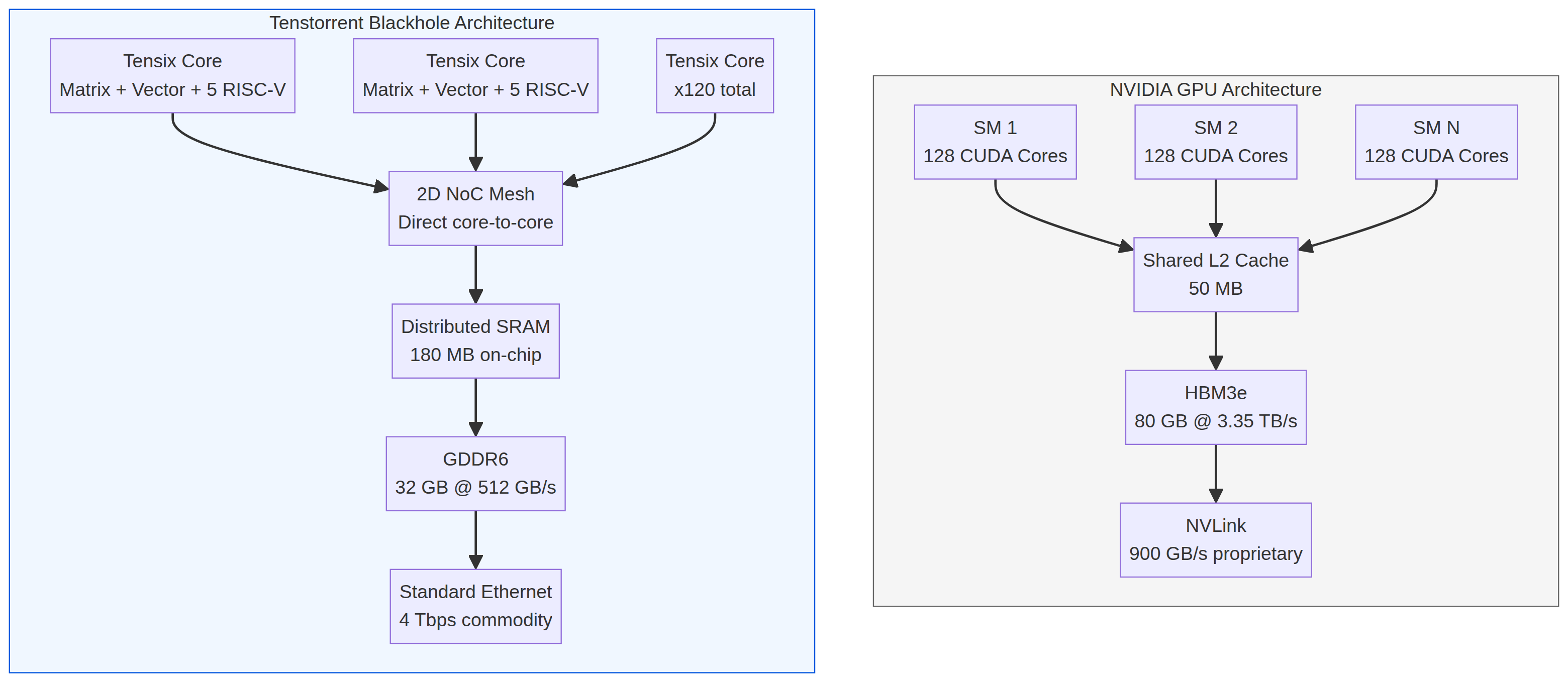
Where NVIDIA builds large, monolithic streaming multiprocessors (SMs) that share memory hierarchies, Blackhole uses a mesh of smaller, independent processing units called Tensix cores. Each Tensix core contains a matrix engine (for the multiply-accumulate operations that dominate neural networks), a vector unit (for activation functions and normalization), and five small RISC-V cores that handle scheduling and data movement [4].
These cores communicate over a 2D network-on-chip (NoC) mesh. There is no shared global memory in the traditional sense. Each core has its own local SRAM, and data moves between cores via explicit message passing over the mesh.
| Component | Blackhole Specification |
|---|---|
| Tensix Cores | 120 (reduced from 140 via firmware, Jan 2026) [5] |
| On-chip SRAM | 180 MB total (distributed across cores) |
| External Memory | 28-32 GB GDDR6 at 448-512 GB/s |
| Compute | 664 TFLOPS (BLOCKFP8) |
| Host CPU | 16 x 64-bit RISC-V cores (can run host-less) |
| Chip-to-chip | 10 x 400 Gbps Ethernet (1 TB/s aggregate) |
| Process Node | TSMC 6nm |
| Power | 300W |
| Price | $999 (p100a) / $1,399 (p150a/b) |
Source: Tenstorrent official specifications [6]
The Anti-HBM Bet
Most high-end AI accelerators use High Bandwidth Memory (HBM), which provides enormous bandwidth but costs significantly more per gigabyte. Blackhole deliberately uses GDDR6 instead, trading peak bandwidth for lower cost and simpler board design [7]. This is a bet that large on-chip SRAM (180 MB) combined with intelligent data scheduling can compensate for lower external memory bandwidth.
The Anti-NVLink Bet
NVIDIA connects GPUs within a server using NVLink, a proprietary high-bandwidth interconnect. Blackhole uses standard Ethernet. Each chip has 4 Tbps of Ethernet connectivity built directly into the silicon [8]. This means systems scale using commodity networking infrastructure. No proprietary switches, cables, or topologies.
The Anti-Disaggregation Bet
The current industry trend is to disaggregate AI inference: use one type of hardware for prefill and another for decode. Tenstorrent's CEO Jim Keller has explicitly bet against this:
"The big fad is disaggregation, special purpose hardware, SRAM. Do you know how many people are going to be talking about that in 2 years? None." [9]
Blackhole runs both prefill and decode on the same silicon. This simplifies deployment but means it may not match specialized hardware on either phase individually.
What Has Been Proven and What Has Not
| Claim | Status | Evidence |
|---|---|---|
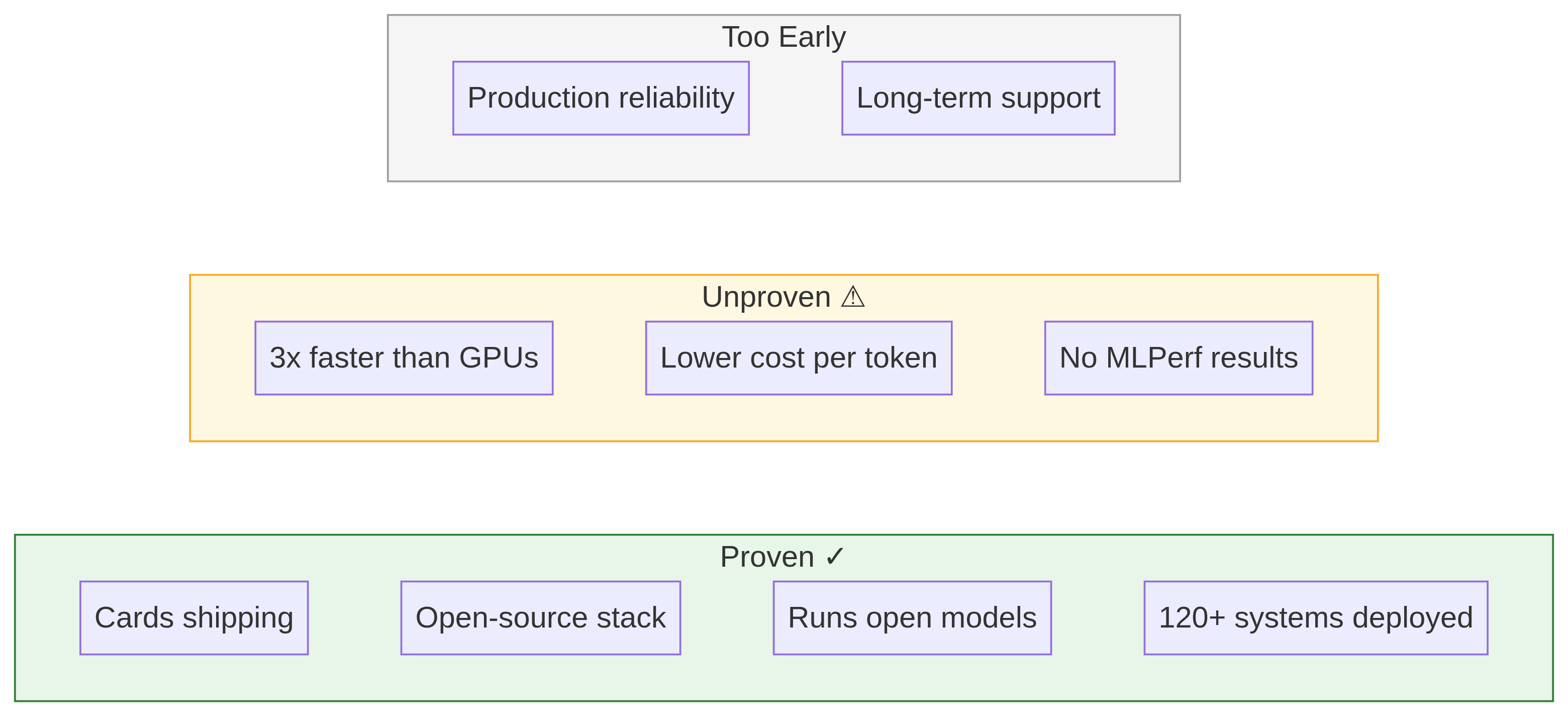
| Cards are shipping and purchasable | Proven | Multiple retailers, customer deployments confirmed |
| Software stack is open source | Proven | GitHub repositories are public, MIT licensed |
| Runs major open-weight models | Proven | Demonstrated at events; ~90% HuggingFace compatibility claimed |
| Performance exceeds NVIDIA on inference | Unproven | No MLPerf submission; all benchmarks vendor-reported [10] |
| Cost per token is lower than NVIDIA | Unproven | No independent TCO analysis published |
| Architecture scales to frontier models | Partially proven | 120+ Galaxy systems deployed in Japan; DeepSeek 671B running |
| Long-term reliability in production | Too early | GA since April 2026; insufficient time for reliability data |
What You Should Do
| If You Are... | Then You Should... |
|---|---|
| Building a new local inference stack with 6+ months before production | Evaluate Blackhole cards ($999) alongside NVIDIA. Run your specific models on both. Measure on your workload, not vendor benchmarks. |
| Already running NVIDIA in production with no issues | Do nothing today. Monitor quarterly. Begin tracking your CUDA dependencies so you understand your lock-in surface area. |
| A startup choosing first inference hardware | Start with NVIDIA for time-to-market. Write your pipeline to be hardware-agnostic where possible (ONNX, framework abstractions). |
| Building sovereign or air-gapped AI infrastructure | Evaluate open-source silicon seriously. The ability to inspect, modify, and independently manufacture your compute stack may outweigh raw performance. |
| An investor or analyst | Watch for independent benchmarks (MLPerf), a hyperscaler deployment, and the Quasar next-gen chip. The technology is real; commercial validation is incomplete. |